rotating banner

Friday, April 6, 2012

The Biggest "Bird" EVER (Was Pretty Much T. rex!)

Remember watching the movie Jurassic Park for the first time, and there’s that scene where the big scaly Tyrannosaurs rex busts through the fence and walks between the stalled Jeeps, growling and snarling and eating goats? It’s scary, intense, and pretty darn realistic – after all several top palaeontologists served as scientific advisors to the film, like Jack Horner, whose current theories are still well respected in the scientific community (/sarcasm). Yeah, turns out that, like most everything Hollywood puts out, Jurassic Park is just a movie, and real life is nothing like it.

To be fair, Jurassic Park was an awesome movie... mostly because of Sam Neill. Sam f'in Neill.

I’ve talked before about the Liaoning shale gardens in northern China, where scientists have been finding exquisite fossils of dinosaurs and birds with their feathers preserved in mind-blowing detail. Until now, these fossils have been of smaller animals, perhaps crow or raven-sized at the largest, but dinosaurs living there ran the size gamut, and some were much larger than their tiny maniraptoran relatives. Much, much larger.

The tiny maniraptoran Mei long, looking just as much bird as dinosaur.
By Ferahgo-the-Assassin via deviantart.

Enter Yutyrannus, a 30-ft-long tyrannosauroid dinosaur that looked decently enough like the Tyrannosaurus we all know and love – top-heavy, with a powerful head filled with sharp teeth, strong muscular legs, and tiny little arms. In all, three Yutyrannus fossils were discovered, and at least one was preserved very similar conditions to recently famous feathered dinosaurs like Microraptor and Anchiornis. All along its body, in long down-like plumes, the Chinese scientists found something never before seen on such an enormous dinosaur – feathers.

Fuzzy tyrannosaurs have been scientifically proven. Your argument is invalid.
By Gorgosardia via deviantart.

Ever since the primitive Dilong, we’ve known that tyrannosaur-like dinosaurs could possess feathers. However, there’s a biological theory that as an animal grows larger, it requires less integument to regulate its internal body heat, much like elephants are pretty much hairless today. So, everybody just kind of assumed that even though the tiny Dilong had feathers, Tyrannosaurus rex was huge and probably just scaly. Now we know that Dilong wasn’t a fluke in the tyrannosaur lineage, and it’s likely all tyrannosaurs were feathered to some extent.

You're gonna have to zoom in to see them, but Yutyrannus's filaments don't lie!
Photo via Sci Tech Update.

Yutyrannus, however, took “some extent” to its full extent. Its feathers were pretty primitive, and lacked the vanes and intricate barbs of bird feathers, so in life the it would have looked pretty furry. Much like northern China is pretty cold today, it may have been even colder in the Cretaceous, meaning Yutyrannus’ feathers were probably used to regulate its body temperature. This has implications for dinosaur fossils found in extreme latitudes like Antarctica and even Australia. Back in the day, the two continents were found quite close to the South Pole, and dinosaurs like Cryolophosaurus probably had similar integument to brave these frigid climes.

Once this reconstruction of Cryolophosaurus was merely speculation - but now it's looking more and more likely!
Photo by Kyoht via deviantart.

There’s another implication, of course. Dinosaurs like Dilong and Yutyrannus were fairly early offshoots of the coelurosaurian family tree, and not particularly closely related to maniraptoran dinosaurs and their progeny, birds. So it seems that feathers, or at least down-like integument, was a primitive feature for these animals. But how primitive? Could the early Dilophosaurus have possessed feathers? Or Coelophysis, one of the most basal therapods?

A slice of life from the Cretaceous? A maniraptoran Mononykid dinosaur feeding its chicks.
Photo by Deinowilly via deviantart.

Dinosaurs evolved along two main lines – ornithischians (plant-eating dinosaurs) and saurischians (meat-eating dinosaurs). All the feathered dinosaurs I’ve talked about today have been saurischians, but the very same shale gardens in China have unveiled several ornithischian dinosaurs that possess odd, hollow, quill-like structures – not feathers in the strictest sense, but similar integument. Some, like the ceratopsian Psittacosaurus, only grew them on the tail, and probably used them for display. But a much more primitive ornithischian, Tianyulong, grew these structures all over its body, and perhaps used them for heat regulation. In short, it was another furry dinosaur, albeit one from a completely different side of the family tree.

Man, dinosaurs have really changed from when I was a kid... for the better, in my opinion!
Photo via MSNBC.

These and other recent fossil finds confirm what paleontologists have known for some time now. Those dinosaurs we today know as birds are not as unique in the ways we once thought. Most dinosaurs grew some type of feathers, and other dinosaurs could fly, some perhaps even capable of powered flight. But truly avian dinosaurs are indeed unique in that everything about today’s birds is completely and totally specialized for one purpose – life on the wing. It’s important to realize that dinosaurs were not the lumbering, scaly beasts depicted in children’s books not a decade ago. Like birds, they were graceful, active, and most importantly, beautiful.

Tuesday, April 3, 2012

#51: Bewick's Wren - Cabrillo National Monument, CA

Long ago, it was possible to find the Bewick’s Wren in North Carolina, high up in the Appalachians. Apparently, the expansion in range of the House and Carolina Wrens extirpated them as a breeding species from the state, which means that in order to get my lifer, I had to travel West. Much more West.

I distinctly remember my lifer. Just after visiting the second parking lot down by the tide pools at Cabrillo National Monument, I heard an odd song coming from the chaparral brush by the sea. It honestly sounded like a weird sparrow, a far cry from the melodic Carolina Wrens I get at home. Yet, sitting atop some evergreen was a wren, a Bewick’s Wren, singing away not feet away from a steep cliff-face.


I brought James back to Cabrillo to find multiple lifers, but the Bewick’s Wren eluded us for some time. We saw Cooper’s Hawks drifting just off a viewing platform, and a covey of California Quails running through the thick cover before I recognized its song once again. A little pishing later, and the wren was chattering quite close to us, yet never giving us those perfect looks. This seems to be commonplace with wrens, and I’m grateful to get the view I did. I had to travel all the way across the country to see it, which is kind of a shame considering they used to nest in the mountains of North Carolina. Species' populations are always in flux, and perhaps they’ll make their way back East on day, but until then – I’ll just have to be satisfied with the Bewick’s Wrens of San Diego

Sunday, April 1, 2012

A Hairful of Snakes

Last Thursday was already a legendary day of herping, what with a Copperhead and a Black Racer, plus those salamanders in the morning. But I had no idea how awesome it was about to get. Enter Duke Forest.

Things started off pretty mundane, and being the late afternoon, there weren’t even birds singing from the trees around the gravel parking lot. As Mark, Ali and I walked down the path, I became startled by what I thought was a rodent running across my feet. Turns out, it was actually an enormous female Eastern Fence Lizard, probably fattened up to start laying eggs. She ran up a tree and just sat there while we watched her, and with a quick grab I managed to catch her. For a good half-mile, she sat in the palm my hand like an Egyptian sphinx, unmoving and beautiful.

Oddly enough, I've never seen a Fence Lizard on a fence.

I had to let her go at some point, and it’s a good thing I did, because not a hundred yards later, I heard a loud rustle of dead leaves on the forest floor. I saw two Black Racers, a smaller male and a huge female, racing down a nearby hill, and without a second thought, Ali ran after them at full speed. When I finally caught up to him, he had his hand down a snake hole, grasping the big female’s tail. With some careful effort, he was able to pull her out, and using Mark’s snake stick, we took turns holding the feisty serpent. Every once in a while, even from a prone position on the ground, she’d rear up and try to bite us on the hand. Not an experience you easily forget!

The big girl almost tagged my finger. Missed me by that much!

As we neared the concrete bridge, we heard the twittering of Chimney Swifts overhead, the truncated songs of Ovenbirds in the deep woods, and the descending melodies of Yellow-throated Warblers from atop old oaks. Truly, spring was here, and this did not escape the notice of snakes. Once we stepped foot on the bridge, Ali bolted into the water, catching Queen Snakes and Northern Water Snakes by the handful. All in all, we saw at least twenty snakes that day at the bridge, and the Water Snakes we saw ran the patterning gamut – some looked banded as they should, and some looked dull brown. But one looked exquisite, sporting bright rufous bands on an ecru background. By far, the prettiest Northern Water Snake I’ve ever seen.

Totally worth it - he nailed my hand, drawing his fair share of blood. My first battle scars!

At one point, mid-way between running after Water Snakes in the rushing creek, Ali reached into the water and pulled this guy out from between some stones. Turns out, we aren’t the best at turtle identification, because we waffled between IDing him as a Musk Turtle and a Mud Turtle. Of course, his lack of a hind plastron hinge over his back legs should have been a solid clue, but it wasn’t until later that we finally decided we was a Musk Turtle. Oddly enough, he didn’t musk at all, and didn’t live up to his species nickname of ‘Stinkpot’. Perhaps it’s because I’d been musked by captured Water Snakes all day, which smell just God-awful.

I almost wish he smelled worse - at least we coulda ID'd him right away!

After successfully photographing a sweet new turtle, Ali decided to go into crazy herper mode and grab a handful of the snakes we’d caught, placing them atop his head to look like the odd love-child of Twisted Sister and Medusa. After coming into some semblance of reason, he let them loose on the bridge, and snakes scattered in eight different directions. Quite the sight to behold, and an awesome ending to an epic day of herping! 

Friday, March 30, 2012

Ol' Blue Eyes

Don’t you just love it when everybody’s schedules match up? Mark, Ali and I all had a free afternoon this past Thursday, and what a better way to spend it than to herp! As Mark was going to show up a little later, Ali and I decided to check out the creek that runs through Battle Park for whatever we could find. ‘Whatever’ turned out to be a whole bunch of adult Southern Two-lined Salamanders, a species that’s pretty common in our area and happens to love running water.

This is the most colorful one we found, in all its mustard-yellow glory!

In all, we caught five salamanders, a pretty good score for being literally on UNC-Chapel Hill’s campus! After Mark showed up, we headed for the venerable transect at Duke Forest’s Gate 22. True to form, a Copperhead was back under one of the boards, thankfully right in the middle and away from anybody’s fingers.

Don't move - a Copperhead can't see us if we don't move!

Ali, being the crazy herper that he is, decided to pick up the venomous snake with the aid of Mark’s snake stick. I don’t know if I’ll ever reach the level of being able to hold Copperheads, but Ali seemed to have no problem with it. Heck, he even kissed the thing! Apparently you’re supposed to do that as a thank you to the snake for not biting you and injecting venom.

Yeah, pretty much the closest I'll ever get to a Copperhead!

We sat the snake down in an open area for better photographs, and he couldn’t have been a more generous subject. A far cry from the Mole Kingsnakes of late, the Copperhead just sat there in a perfect pose, allowing shot after shot, without moving a muscle. Of course, once he did try to get away, Ali employed the snake stick once again, and the Copperhead reared back and struck the stick. As we saw no dripping venom, it looks to’ve been a dry bite, and the snake stick seemed no worse for wear, but it’s a humbling reminder that these snakes are in fact dangerous.

Like the eponymous character in the movie Kill Bill - beautiful, yet deadly.

Off the transect, we flipped boards over by some dilapidated barns. Nothing much going on except a nice White-spotted Slimy Salamander and a Blue-gray Gnatcatcher singing from the low trees. As we flipped one promising tin, Ali noticed a small black serpent, and immediately grabbed it. It was a Black Racer, but far from normal racer behavior, it didn’t thrash and refused to bite. Then I saw why.

Would that make it a Blue-Eyes Black Racer?

The snake, it turns out, was very close to shedding its skin. As it gets closer to molting, the membrane over the snake's eyes becomes cloudy, and in racers this leads to an interesting phenomenon – its eyes become a brilliant shade of Carolina blue. I could have photographed this docile little racer for hours, but after getting our shots, we decided to let it have some peace and quiet as it began to shed its skin. The whole thing was an amazing up-close experience that I rarely get to have with these snakes. But we had other spots to hit this afternoon, and like the Beatles song, the day just kept on getting better, and better all the time...

To be continued!

Tuesday, March 27, 2012

Linus and the Queen Snakes

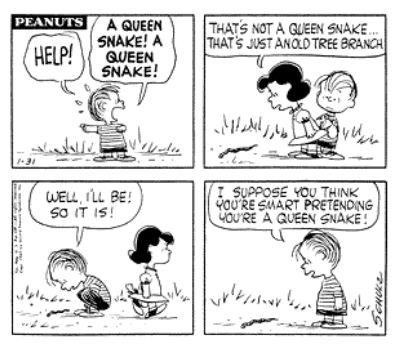
When I was a kid, I’d read the daily comic strip Peanuts in the papers. I may have been too young to understand its genius, but the classic image of Lucy pulling away the football just before Charlie Brown kicks it is too good for anyone to ignore. But another Peanuts tidbit always stuck with me – occasionally, Linus would find a branch on the ground and mistake it for a Queen Snake.

Until very recently, it never registered that a Queen Snake was in fact a real animal, and no different from the Rough Greens and Black Rats I’d been finding for several weeks. Yet, like so many species for me, it seemed so far out of reach. So when Ali and I met up with Duke University professor Jeff Pippen to find some herps at his old transect sites, we had a mission in the back of our minds: we must find a Queen Snake.

Of course, as often happens in life, we came up empty. The old plywood boards had rotted away and the salamanders they once held had ventured underground to await another season. We did find one large Five-lined Skink, but we couldn’t find the snakes we so craved. At one of the sites, we found this Eastern Fence Lizard chilling on a log right in front of us. It didn’t seem to mind us standing there photograph it, and we were only happy to oblige.

Pretty cool, but not what we came for.

Eventually, we ended up at a large field littered with plywood and tins to flip. As Jeff grabbed the corner of one of the boards, he let out a small “woah.” He’s a seasoned pro, and he’s not about to let a sight like this faze him. Under the very corner he’d just lifted lay a fat, coiled Copperhead.

Better to stay cool than make it angry. You won't like it when it's angry.

Copperheads are by far the most common venomous snake we get in these parts, but for some reason I’ve not come across one in some time. Perhaps I’ve just been looking in the wrong places, but here on the edge of the forest under a bit of wood seems to’ve been the perfect spot for this snake. As with any venomous snake, we respected its space and photographed it from a distance. Well, not too far a distance – I mean, I did want an awesome shot!

Awesomely enough, the song "Copperhead Road" came on the radio as we were driving home!

Flipping more boards revealed networks of tunnels likely dug by Hispid Cotton Rats, pretty much the default rodent around here. That doesn’t escape the notice of our local snakes, because one flip later we found this guy curled up next to a small mammal nest of dried grasses. He was a Mole Kingsnake, a rather secretive serpent that prefers to burrow underground rather than cruise in the open. Luckily, he happened to be curled up in a couple mammal tunnels, and we were able to check him out at close range.

Apparently not a snake you get to see every day - lucky me!

After our success at the transects, Ali and I decided to check one more spot – the Korstian Division of Duke Forest, a great place by any means. Mostly I’ll bird there, but recently the herping hasn’t been bad either. In fact, just a couple hundred yards down the trail we found this nice Ground Skink among the leaf litter.

And moved him out to the trail for better pictures of course!

As I lay on the trail to photograph him, the skink stopped scurrying away, and started towards me – apparently he needed some kind of cover, and I was the closest thing to it! The Ground Skink kept on creeping into my shadow, and I would move to get it in the light again, a kind of tango that lasted for several minutes. Eventually I gave up, content that he was so unwillingly obliging.

No, what're you doing? Get farther away from me!

We walked down to the old wooden bridge and checked the rocks for snakes. Nothing doing, and the nearby dirt path held nothing but Cricket and Pickerel Frogs. Dragonflies zoomed to and fro, taunting us as we continued to search for our quarry. Every once in a while, we’d spot some movement in the trail ahead, only to find a snake plummeting from a tangle of branches just above the water’s surface, disappearing into the rushing creek. Suddenly, Ali stopped in the path – “That’s it!” he exclaimed! “It’s a Queen Snake!”

"It's on the branch. No the branch right in front of you. No, the other branch right in front of you!"

With deftness I didn’t possess, Ali bounded down the river bank and grabbed the snake in what I swear was mid-plummet. While he held it, the Queen Snake tried to bite him like any water snake would, though not as ferociously. As it transferred hands, the snake musked me, and unlike its larger Nerodia cousins, it smelled almost pleasant, like freshly crushed oak leaves.

The things security blankets are made of.

As Ali posed it, I couldn’t help thinking that with its dark olive coloration, the snake could easily be mistaken for a branch. Only, Queen Snakes don’t like to hang out in the middle of paths where Linus would have seen it – perhaps Charles Schulz knew this, and put it in his comic as an in-joke to snake lovers. Or perhaps, like with me, the Queen Snake was an unattainable species that he could only have dreamed about. We’ll never know, but I like to think that maybe the creator of Peanuts was a secret herper. Just maybe.

Thursday, March 22, 2012

Herping the Day Away

Early this week, I looked at the seven-day weather forecast and saw nothing but dark gray clouds with little lightning bolts shooting out of them. Not good for birding, much less photography, but nowadays I can always get my nature fix by doing a little herping. On a rumor that you can find Queen Snakes and Red Salamanders, Mark and I headed down to the concrete bridge at Duke Forest Gate 23.

Not a tenth of a mile into the trail, we found our first herp – a large Fowler’s Toad hopping next to the path. As we got low to photograph him, a fly came by and landed on his head. The toad didn’t seem to mind (or really even notice), and I half expected to see him flip up a long tongue and eat the thing right off his face. Of course, nature doesn’t really mirror Saturday morning cartoons, and he just sat there looking irritated like toads do. Perhaps a beetle or worm would make an easier meal.

Somehow I get the idea that this does not please him...

Herping in Duke Forest proved what I’ve found to be true time and time again – peeling off bark is a great way to find herps! This time, a rotten log accidentally came apart in my hand, and from under the bark slithered out a relatively large Worm Snake. Now, I say relatively large because he was only like a foot long, but he was a giant among Worms. He was very wriggly and tried to bury himself into my hand, using a combination of his spade-shaped head and a small spike at the end of his tail. Eventually we got him to settle down and so we could take this shot on his level.

Oddly enough, the most difficult to photograph snake I've ever encountered!

As we reached the concrete bridge, we found that last night's rains had raised the water level far higher than I expected. Water coursed several inches over concrete, and as our way was blocked, we decided to take a small dirt trail that ran parallel to the river. We couldn’t find any of the promised Queen Snakes and flipping logs failed to reveal salamanders, but while checking out a wood pile on the riverbank, I heard rustling near my foot. I looked down to see I’d almost stepped on a big thick Northern Water Snake! Knowing their propensity for biting, I quickly moved out of the way and tried to use a stick to move it out into the open. No luck, but I did find this much smaller one that nevertheless bit me three times and then musked for good measure.

At least he wasn't big enough to break the skin and inject some nasty serotonin.

On the way back home, we kept hearing peepers and chorus frogs calling from deep in the woods. At one point, as we passed a government building, the frogs were almost deafening. I remembered there was a small pond behind the building, and we pulled over to see what we could find. Sure enough, Spring Peepers were everywhere, and loud! Mark and I had to yell at each other just to hear ourselves! Apparently the males are in full breeding mode, because they would just sit there calling as you got down low to photograph them. Not that I’m complaining or anything. Just it was really cool!

Often heard but seldom seen - until you can find a pond with hundreds of them calling!

The next day I had a couple hours to kill, so ­I headed for Mason Farm to see if the herps were out. My juvenile Black Ratsnake was back under his bark (and yet again he bit me), but I wasn’t finding as much under the logs as I usually do. Peeking under tree bark again, I found this adult Five-lined Skink, and learning my lesson from last time, I attempted to catch it. After one hell of a chase (lizards are fast!) I finally nabbed it, and stopped it from wriggling just long enough to get this shot.

It sounds odd, but I found this large adult rather... squishy...

As I walked through the woods, I heard some rustling in the undergrowth, and yesterday rustling meant there was certainly a Ground Skink around. But when I found the source, I was surprised to find this White-spotted Slimy Salamander, my first free-walking amphibian. Eventually it decided to stop running and hid under some leaves, so I slowly peeled them back until he was totally exposed in the late afternoon sun.

True to its name, it was extremely spotty... and extremely slimy!

Man, the herping’s been pretty good recently – so good in fact that I almost forgot this is supposed to be a birding blog! Spring is definitely here, and the woodlands are full of Northern Parulas singing their heads off, with Common Yellowthroats wichity-wichitying through the fields.

Oh man. I almost forgot how awesome birding was!

In just a couple weeks, migration will be in full swing, and pretty soon all those crazy neotropic migrants are going to be gracing our state. Once the Black-throated Blues and Hoodeds start belting out from the forest, I’ll probably forget the yellowthroats even exist. But until then, this tiny warbler is way more colorful than anything I’ve seen all winter – and damn, it looks awesome!

Tuesday, March 20, 2012

A Totally Accurate Scientific Theory on Avian Physics

Over the past six months, I’ve taken up what can only be described as bird photography. While I’m still not as good at it as James, I’m getting there, and you can see many of the results right here on the blog. But bird photography is frustrating, and on more than one occasion I’ve had my viewfinder perfectly focused on a subject only to have it disappear just before I depress the shutter. It’s happened so many times, in fact, that I’ve been able to come up with a rigorously tested and undeniably scientific theory as to why. Simply, birds exist in a separate quantum state from every other living thing on Earth.

How else can you explain this nth-dimensional Ruby-crowned Kinglet?

You may ask yourself, how is this possible? How do I work this? Where is your large automobile? As the days go by… dang, lost my train of thought! Back to the point: like I said, The Quantum Theory of Birds is simple, much like quantum physics itself. Literally anybody can understand it. If a bird occupies a position in space, but that position is struck by photons reflected by, say, a camera lens or a pair of binoculars, the bird switches quantum states and exists in a dimension that we, as humans, cannot perceive.

Ready your optics and... poof! No Northern Cardinal!

To put it in laymen’s terms, Δx Δp ≥ h/4π, where Δx Δp is the bird’s position in space and h/4π is like tacos or something. In physics, variables are whatever we want them to be. So while I was eating a taco one day (totally unrelated taco), I noticed a nice Yellow-rumped Warbler sunning itself on my porch, right in the light. How could I refuse the opportunity? I took my camera, aimed it out the open window, and fired a single shot, and… it worked! Finally, a bird whose quantum state remains unchanged when faced with a camera!

Mwahaha, a successful photograph! Man: 1, Quantum Physics:...8642... wait, that can't be right...

But the bird was preening, I wanted that perfect look. I steadied myself for another shot. All of a sudden…

Gone! Vanished! Disappeared! Dematerialized! Apoptosed!

Damn you physics! The Yellow-rumped Warbler had clearly and spontaneously flipped dimensions on me. Perhaps it still existed in some five dimensional space where time has little meaning and quarks control the media. But to my eyes, it had disappeared, forever lost to humanity and our lackluster quantum existence.

Or you know, maybe it flew off or something. I didn’t really see what happened.