James and I were at San Elijo Lagoon near Encinitas, finding awesome birds like American Bittern and breeding plumaged American Avocet. While I was scoping the far impoundments for Long-billed Dowitcher, I heard an odd call, and immediately I turned my attention to the bush behind me. Meanwhile, James decided he would scout up the road a bit, and when my mystery bird turned out to be nothing more than a Common Yellowthroat (man they sound different from my eastern birds!), I decided to follow James’s tracks in the sand.
Right before we met up, I noticed something in the road between us. I thought it was a stick at first, but after getting it in my binocs, it turned out to be a beautiful California Kingsnake! Now, having never seen any other subspecies of Common Kingsnake, I’m not quite sure what the difference is, but I think it’s got something to do with the thickness of the pale striping. Still, it was a brilliant-looking snake, and a really confiding one at that.
Contrary to the Red Hot Chili Peppers, this is not the same thing as a sidewinder.
James tried to sneak a little closer and photograph it in macro, but the kingsnake quickly slithered itself off the trail and into the nearby scrub. For the rest of the trip, I’d only see one more snake (a nice California Whipsnake at Cabrillo, but no pictures of that one unfortunately). So in the absence of rattlers, racers, and the rest, this shot of a sweet California Kingsnake is the only memento I have of California’s awesome serpents.
It’s the second lifer I got in California. The first, of course, was a big Western Gull hanging out on a light post on San DiegoAirport. However, just afterwards I headed down to the Famosa Slough in residential Point Loma, and I didn’t get past the parking lot before a bird hopped off the ground and into a nearby bush. I’d never seen it before, but the blue and gray patterns were totally unmistakeable – it was a Western Scrub-Jay.
Out East we only get one kind of jay, and it’s pretty much the exact opposite of its West Coast relative. The Blue Jay is a positively gaudy bird, bright blue with a flamboyant crest, but its personality really sets it apart. Blue Jays are loud, raucous birds that will call from the tops of trees, and mob large raptors with great audacity, yet are strangely skittish around humans. The Western Scrub-Jay however is rarely seen more than a couple feet off the ground, preferring to hang out in bushes. And, unlike its bluer cousin, I found the Western Scrub-Jays of San Diego incredibly inquisitive and quite confident around people.
I would say they look cooler than Blue Jays... but I mean, come on, Blue Jays!
Apparently, they seem to enjoy parking lots. Like my first sighting, James and I pulled up to the parking lot of CabrilloNational Monument and immediately we found this guy calling his heart out. It’s hard to go anywhere in California without hearing the rawk! of a Western Scrub-Jay, and lucky for us East-coasters, they happen to be awesome and confiding!
Who’da thunk it? Just a month after James and I rushed down to Pinehurst for a beautiful male Western Tanager, I received a phone-call from Ali Iyoob apprising me of a second individual, a female – and pretty much in my own back yard. The bird had been coming to a feeder in northern Durham, but a combination of strong winds and extreme cold made me wonder whether the bird would survive the night. Nevertheless, the next morning I headed out with Mark and Nate to check out this awesome find, and we weren’t disappointed – almost immediately, a bird looking much like a giant goldfinch flew into a tree right in front of us, allowing for spectacular photos! Oh, wait…
Alas, we meet again - my old nemesis, Stick-Through-the-Face!
Nevermind that, it was only a fluke. The Western Tanager flew off from its perch across the street, but I would get my shot when it returned. In the meantime, we had plenty of bird life to occupy us as we waited in the cold and wind. American Goldfinches were plentiful, and several smart-looking Northern Cardinals chased each other around a small hedge. Then, without warning, a whole flock of birds flew in, including a saffron rocket that landed in the pine right above me – this was my chance, my one perfect shot!
Damn! Foiled again! What a dastardly foe...
Still, it was awesome to see this western species so close to home. As we left, we happened to glance at the feeder complex across the street. Among the multitude of House Finches stuffing their faces full of nyjer seed, we noticed an altogether raspberry bird, totally out of place even from a distance. Upon taking a closer look, we found ourselves looking at a male Purple Finch, a good bird this year considering the finch stock has been running low – I mean, how long has it been since you saw a Pine Siskin? Making the best of our morning, we ran around getting additional county ticks for everyone, including Hooded Mergansers for Mark and Mute Swan for myself. Still, nothing quite measured up to the little subdivision with two awesome birds.
All birding is relative - I've seen more Western Tanagers than Purple Finch this year!
But the day was still young; we had places to be and birds to see there! Mark and I parted ways from Nate and headed to the New Hope Waterfowl Impoundment – ordinarily it’s nothing special, but it was kind of on the way home and Mark wanted his Durham county Brown Creeper. We totally dipped on any sort of creeping birds, but on the cement causeway, we found a small cadre of Ruby-crowned Kinglets foraging along the swampy bottom. A little pishing here and a little playback there, and one of the males reared his namesake feathers and started going crazy.
He's got a better punk-rock 'do than Sid Vicious!
I was shocked at how brazen this little four-inch bird thought himself. He would occasionally forage on the trees around us, but he focused the bulk of his attention on the two humans in his territory. From his base of operations in a nearby bush, he’d make little sorties to buzz right by Mark, or check out the algae-filled no-man’s land between us. At one point, the comparatively tiny kinglet landed not three inches from my size-11 shoe, completely oblivious to the fact that I towered above him. At this distance, my camera couldn’t possibly auto-focus, but he hung out so close I had no problem snapping several dozen awesome shots.
To infinity, and... well honestly, like a foot away.
Eventually, the Ruby-crowned Kinglet ended his campaign, preferring to focus on food and females. Throughout the years, I’ve had many close calls with these boisterous little birds, but none have come so close I that could have stepped on them were I not careful. The whole experience was definitely one of the coolest of the day – and on a day that included a vagrant Western Tanager, that’s nothing to sneeze at!
Unless you happened to be allergic to kinglets, I guess!
On the ferry back from CarolinaBeach, I noticed some of North Carolina’s more rural residents throwing bread to the gulls off the back of the boat. As they were all gathered in one place, it was really easy to pick out what species were present. Mostly we saw Ring-billed Gulls, easily the most common gull we get in the winter.
I've counted tens of thousands in one day, not something to be done lightly!
They would literally come down and pick the food out of people’s hands! So many gulls were going for the food that they’d even get fooled if you just extended your hand… not that I did it.
Oh wait... I totally did!
Among the enumerable Ring-billed Gulls, I spotted a couple brown juvenile Herring Gulls – their coloration made them stick out in the crowd, but so did their size. Close in size to the Ring-billeds though were a couple Laughing Gulls, a bird I’d thought was pretty good in the winter. Turns out, not so much – we probably saw a solid dozen of the course of a couple days.
They see me flyin'... they hatin'...
There were even multiple Laughing Gulls in this very flock! The best way to tell them apart is by checking the darker mantle color, but the dusky coloration on the head doesn’t hurt. When they’re landed, the white tips to the primaries are pretty obvious – in fact, as one trip participant put it, it looks like their primaries were pooped on by another gull.
Apparently, it helps them edge out other gulls for food!
The gulls weren’t the only ones looking for a handout – all along the deck, Boat-tailed Grackles sang mechanically and dove for any food the gulls missed. Mostly I saw a couple males, full tailed and everything.
Turns out, Boat-tailed Grackles like to hitchhike, but only when there's free lunch.
But occasionally, a female would take up the post a call a couple chip notes before moving on.
Some bread crust brings all the girls to the yard.
The light was so good that I was able to catch a couple of the grackles with their nictitating membranes up. Birds don’t blink, so instead they have a third membrane that travels across the eye to moisten it while still maintaining visual acuity. I even got one grackle mid nicti... tate!
Pretty sure that's what they call it.
Of course, once we got back to Southport, the party wasn’t over. On a lawn near the waterfront, people were once again feeding the birds, this time with a left-over back of pretzels. Where there are gulls, and there’s food… pandemonium ensues.
It's like a scene right outta that one Hitchcock film... crap, what's it called again?
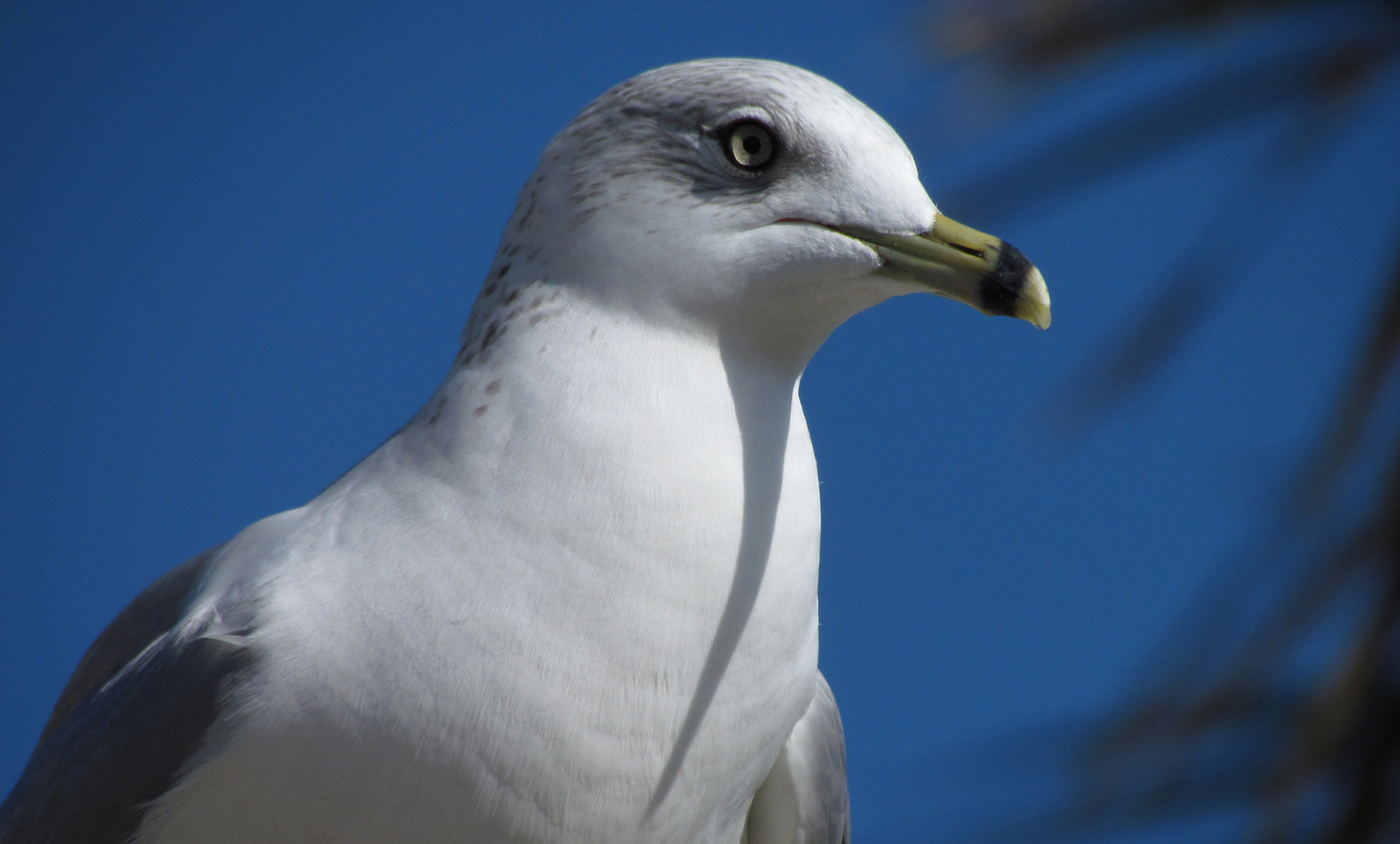
Finally, the feeding frenzy died down, and one of the Ring-billed Gulls landed on a post right next to me. Seizing the opportunity, I took this portrait shot of the gull, undoubtedly the best I’ve ever taken, and probably the only one I’ll ever need.
This angle makes him look almost regal!
After that, we spent the evening looking at Clapper Rails, Bald Eagles, and Red-cockaded Woodpeckers. Sure these are all “better” birds, but it turns out nothing’s quite as photogenic as Ring-billed Gulls and Boat-tailed Grackles when there’s food around. I mean, when they’re that close, they’re just asking to be photographed. And I’m more than happy to oblige!
The sun blazed over the horizon as we sat huddled against the cold at the end of Johnny Mercer’s pier. Normally it’s a place you would scarcely give a second look. But every winter the pier is home to a large flock of Common Loons, which makes it a prime spot to scan for the rare Pacific Loon. In fact, the loon in question had been seen the previous day, which made sitting in the cold early on a Sunday morning all the more appealing. The day was shaping up to be gorgeous, which presented a problem for us birders – rather than staying close in by the pier, the loons were already far out to sea, making further identification impossible. Oh well, at least we were able to amuse ourselves with some obliging Ruddy Turnstones that ran around the pier nipping at bits of old fish.
This one kept running away while staying out of the perfect light... pretty sure it was mocking me.
After our failure at the pier, we decided to travel a scant mile down the road to check out the jetties that line Masonboro Inlet. At first it seemed like we were sunk – we arrived at the middle of high tide, and the low stone jetty was underneath several feet of water. I thought there’d be no way the little ducks would stick around, but sure enough the call went up that a trio of birds were riding the swells next to a pylon. Sure the light was bad, and the constant up and down motion made photography difficult, but there’s no mistaking the three little Harlequin Duck we saw that morning. Plus there were Great Cormorants and Purple Sandpipers on the nearby rocks, it’s like we were birding in the northeast or something!
Yeah, I know I used this last week... but it's my only decent shot!
As the day had been set aside for chasing rarities, we immediately headed for the Black-chinned Hummingbird I mentioned in last week’s post. But I’ve already gone over that bird in great detail, so after getting our bird we left for the nearby OleanderMemorialGardens, a nice little cemetery that ordinarily wouldn’t seem too great for birds. Just, somebody had seen a Mottled Duck there recently, and as obligate chasers, we had to check it out. Upon arrival however, we found the pond filled with American Wigeon, Gadwall, and even a large Mute Swan, but no Mottled Duck. A couple of the nearby American Black Ducks had very yellow bills, but nothing could quite match our quarry. A single drake Redhead mingled amongst the other waterfowl, standing out like a beacon amongst a sea of relative uniformity.
I don't see Redheads nearly enough. Also, the ducks are nice too.
The day was almost up and we had to get going back to the Triangle, so we decided to check just one more spot – GreenfieldLake, a small recreational area near downtown Wilmington. We’d been hoping to find an Anhinga, but the rare winter visitor never materialized amid the dross of Ring-billed Gulls and nearly-domesticated Mallards. Among the Mallards, however, and not feet from the raucous park-goers, a pair of American Black Ducks made themselves right at home. Apparently they’d taken to the flock of Mallards during their wintertime interlude and found the plethora of free bread appealing. Normally it’s a species that’s pretty skittish, so it was nice to finally see them up close and personal.
Photography is actually incredibly difficult when your subject is less than three feet off!
The awesome black ducks couldn’t make up for the fact that we were Anhinga-less, even after trying to turn every other cormorant into something better. The sun shone low in the sky as I rolled up my sleeves to cope with the mid-70s weather. On a nearby bridge, we watched a beautiful male Great Egret, his plumes already grown in and his lores turning green. If that’s not a sign that spring is almost upon us, I don’t know what is.
::Robert's Note:: Get it, like that Tag Team song from the mid-90s? Yeah, that just happened. Anyway, earlier this year, James finally got his lifer Barred Owl after a long and arduous search. This is his story of that fateful morning...
Owls have always caused problems for me. With a combination of bad luck, my love of sleep, and needing to have pictures for my life list (which makes night owling totally useless), it took me a year and a half and almost 300 life birds to finally get my first owl. Funnily enough, that first owl proved to be the difficult to find Northern Saw-whet Owl on top of Roan Mountain last summer.
Not saying it was the best trip ever but... yeah, it pretty much was
So when I headed home for Christmas break, my goal was to get a Barred Owl. After many failed missions at Mason Farm and a close call in my neighborhood, I saw via eBird that they'd been seen regularly at a small park in west Raleigh. I waited for a day that was supposed to be clear and took an early morning trip out there. I walked the trail that was supposedly the place to find the high roosting birds, and once again – nothing. I decided to pull out my speakers and try a little playback. After a couple seconds, no reply. I walked another hundred yards and tried again. After a long pause, I thought I was sunk… then clearly from across the pond, finally, a response!
I had my doubts, thinking there might be another birder trying the very same trick, but I decided to run over towards the call’s location. I waited for a few minutes and didn’t hear anything, so I decided to try again. The speaker played out the powerful Barred Owlhoot, hoot; and there it was! Almost immediately after I turned on the speakers, a large bird glided silently through the trees, and landed about sixty feet up in the pine.
I've heard Barred Owls are curious, but this takes it to a whole new level!
The owl put on quite a show, vocalizing for several minutes, and was in no way concerned with the joggers underneath who would pause momentarily trying to find out what was making all the racket. Eventually, after I had snapped probably fifty to sixty pictures and a video, chickadees and titmice showed up to harass the owl, sending him swooping off his perch and deep into the forest. But no matter – I had finally gotten my lifer Barred Owl!
I bet he thinks we humans are totally insignificant from up there.
The trip to Bond Park also yielded fantastic looks at a Double-crested Cormorant and Hooded Merganser, but nothing could be nearly as cool as a Barred Owl. Now I just have to find the other two owls that frequent the Triangle – the powerful but scarce Great-horned Owl, and of course the tiny, enigmatic Screech-Owl (which Robert got just a week after I left for college again, what an asshole!)
You know, when you think about it, one hell of an awesome duck!
::Robert's Note:: Haters gonna hate! Anyway, check back Monday for the last write-up of my trip to southeastern North Carolina!
For a number of weeks now, Bruce Smithson’s sugar feeder has been visited by two female-type Archilochus hummingbirds. One is almost certainly a female Ruby-throated Hummingbird – it shows a clean white underside and a straight, short bill. The other bird, however, looks slightly different. The breast area is slightly dusky, and the bill is longer and decurved. Michael McCloy, Ali Iyoob, and Matt Daw all went down to see the bird earlier this month, and after reviewing their pictures, I couldn’t be sure whether or not the bird was just an odd Ruby-throated. Mike maintained the bird’s identity, and said it was quite easy to identify because of its unique behavior. Apparently, the hummer would continuously pump its tail as it hovered at the feeder. The only Archilochus hummingbird to exhibit this behavior is the rare for North CarolinaBlack-chinned Hummingbird.
Not that I didn’t believe him, but I couldn’t imagine mere behavior separating two closely related species so obviously. Hummingbird expert Susan Campbell added more evidence against the Black-chinned identification in an email to the CarolinaBirds listserv. Tail pumping, she said, can be exhibited by coastal Ruby-throats as they attempt to steer in wind, and plumage can’t be properly ascertained because Archilochus hummingbirds molt at this time of the year. My spirits weren’t high when I drove up with Aaron and Kayla of Anywhere, Earthto check out the bird this past Sunday. I mean, after successfully having seen the three Harlequin Ducks at Masonboro Inlet, how could we possibly pass up this potential rarity a scant 15 minutes away?
Because yeah, that totally happened! My lame shot does not do these birds justice.
As we piled out of the car, we met Nate, Scott, and Mike, who’d already staked out their spots on Bruce’s lawn (and each of whom have their own blogs; what was this, some kind of blogging convention?). We enjoyed the yard birds and county ticks we all got, but we were really here for one bird and one bird only. While I watched a Brown Creeper making his way up a pine, I heard the tell-tale squeaks of a hummingbird, and watched a blurry shape rocket from a row of hedges. The bird hovered for a second, tail flicking sporadically, before perching itself on the rim of the feeder. This had to be the bird, I thought, it was doing the tail motion and everything! But common sense overruled – the bird was much too clean underneath, it’s bill far too straight. Merely a female Ruby-throated.
Remember what this bird looks like. It'll be important in about a paragraph or so.
Perhaps this identification was going to be more difficult than I thought; as I watched the female feed, she continued to flick her tail intermittingly. She seemed very skittish to me as she sat on the feeder, constantly looking around and finishing its meal in just seconds before buzzing off again. A second, male Ruby-throated Hummingbird also landed at the feeder, and again, it seemed quite cautious. No hummers visited the feeders for a good ten minutes after that, and I began to worry that this may turn into my second dip of the day (damn you Pacific Loon). Then, more squeaks, and another hummer zoomed over to the feeder. And man, she couldn’t have been more different.
Next time I'll have to find a male with a full-on gorget... but for now, this'll do.
The bird hovered for a good while before landing, its tail giving constant rhythmic pumps the entire time. It sat on the feeder and dipped its bill, totally unconcerned about the throng of birders watching it just yards away. She alighted, and just when I thought she’d flown off for good, the hummer returned to hovering and tail pumping, and then back down for more sugar water. The entire encounter lasted a solid thirty seconds, allowing us to pick apart its plumage, noting the dusky breast and the long, curved bill I’d been promised. Before long, the Black-chinned Hummingbird finished feeding and flew off towards her chosen perch. Before coming here, I really struggled to think that a hummer could appear so different just based on behavior, but now I’m a believer. Don’t take my word for it though – check out this sweet HD video I got of the little guy:
Click through to Youtube for HD quality!
No longer having any doubt as to their identification, we left the hummers in peace. At this point, it was just after noon, and the day was young. We still had a couple spots to hit up, and some more awesome birds to see. Check back Saturday for ducks, ducks, and… well, more ducks!